Israel + Serbia Tech Acceleration
Bilateral Innovation, Investment, and Growth
Executive Summary
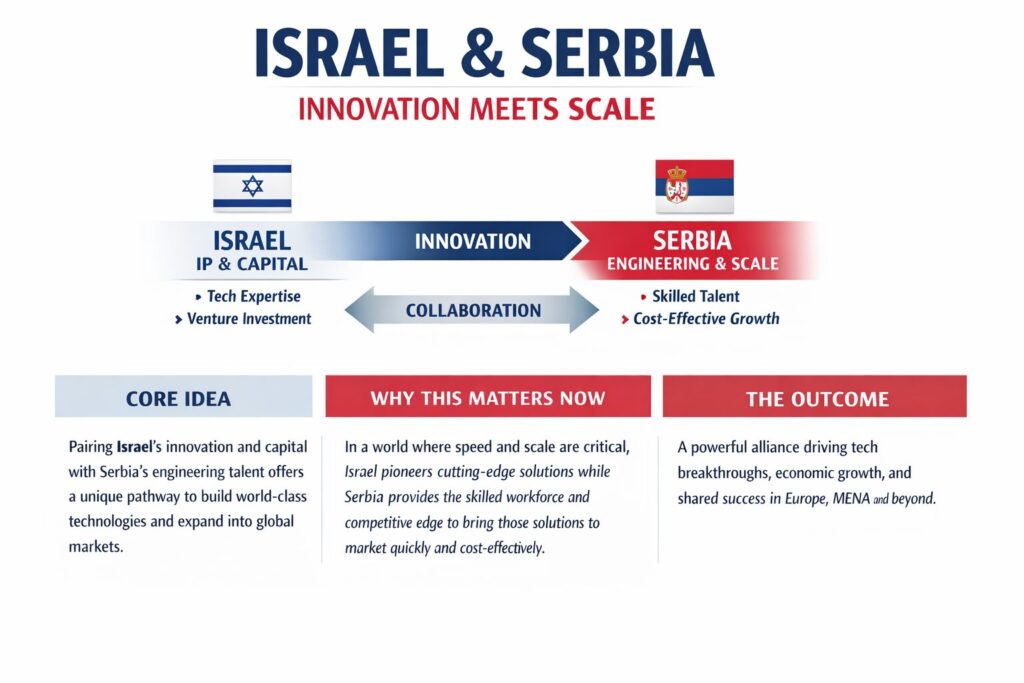
Israel and Serbia are uniquely positioned to form a high-impact, long-term technology partnership. Israel, globally recognized as the “Startup Nation,” excels in frontier innovation, venture capital formation, and deep-tech commercialization. Serbia, Europe’s fastest-rising engineering and software hub, offers world-class technical talent, cost efficiency, and strategic geographic access to the EU and broader European markets.
This whitepaper outlines the strategic rationale, economic logic, and practical execution models for deepening Israeli–Serbian collaboration across technology, venture capital, R&D, and scale-up operations. It demonstrates that this partnership is not speculative—but already underway—and proposes concrete mechanisms to institutionalize and scale it.
Key Opportunities
✅ Joint Ventures – Israeli R&D meets Serbian engineering talent (e.g., cybersecurity, AI, semiconductors).
✅ Market Expansion – Serbia = EU gateway; Israel = market for services + bridge to MENA & North America.
✅ Investment Growth – Israeli VC funds invested $1.5B in Europe in 2023—Serbia is the next frontier.
✅ Skills & Innovation – 50+ Israeli tech unicorns could scale faster with Serbian dev teams.
1. Strategic Rationale: Why Israel–Serbia, Why Now
1.1 Complementary Strengths
Israel
- Global leader in early-stage innovation and venture creation
- #1 globally in VC investment per capita
- $140B+ in tech exits since 2020
- Deep expertise and global leadership in cybersecurity, AI, semiconductors, agritech, and defense-related technologies
- Strong access to U.S., MENA, and global capital markets
Serbia
- One of Europe’s fastest-growing tech ecosystems
- ~20% annual IT sector growth
- 50,000+ highly skilled IT professionals
- Engineering and development costs 30–60% lower than Western Europe
- Strong math, computer science, and engineering tradition
- MFST, AMD, DataBricks, Perplexity, BlackRock presense
Together, Israel and Serbia form a full-stack innovation engine: Israeli ideation, IP creation, and capital paired with Serbian engineering scale, execution, and operational efficiency.
1.2 Macro Tailwinds
- Rising costs and talent shortages
- Increased Israeli VC deployment into Europe
- EU market access pressures for Israeli companies
- Global demand for resilient, distributed R&D and engineering teams
Serbia emerges as a natural partner and next frontier for Israeli tech expansion.
2. Proof Points: Collaboration Already in Motion
There’s already a significant collaboration between Israeli and Serbian companies and markets across several domains and industries. To name a few examples:
- NextSilicon (Semiconductors/Computing) – $1.5B valuation; teams in Belgrade and Niš
- Vtool (Semiconductors) – ~100 employees in Belgrade; founder based in Serbia
- Fireblocks (Digital Assets) – $8B valuation; team in Serbia
- Team Sava – Serbian engineers serving Israeli hi-tech companies
- PlayStudios – Acquisition of a Belgrade gaming studio
- Fortrade Group ↔ Kapital.rs acquistion
These examples validate Serbia as a trusted, strategic extension of Israeli tech operations.
3. High-Potential Sectors for Collaboration
Serbia possesses a concentrated pool of highly skilled engineers in semiconductors, AI, blockchain, and advanced software systems. While the overall talent base is smaller than in Israel or larger EU countries, the quality of Serbian engineers is recognized globally. This creates a unique opportunity: Israeli technology companies, many of which operate at the cutting edge of innovation, can leverage Serbian high-end engineering capabilities to scale development, accelerate product timelines, and access scarce expertise.
Proven Strategic Fit
High-end engineering roles are modular, output-focused, and remote-friendly, which aligns perfectly with cross-border collaboration. Israeli companies benefit from:
- Immediate access to high-quality technical talent
- Remote, scalable contributions without establishing a local office
- Lower operational costs relative to local hires in Israel
This model has already been validated by companies operating in Serbia, demonstrating a low-friction pathway for collaboration.
3.1 Silicon: Computing & Semiconductors
Israel is a global leader in hardware, chips, and next-generation computing — punching far above its weight.
More importantly, several Israeli semiconductor companies already have a serious presence in Serbia, employing hundreds of engineers, including one unicorn.
This already works — and it’s scalable.
3.2 Data & AI
The future of AI is being built in Tel Aviv — from foundation models (Safe Superintelligence) and self-driving systems to AI applications and hundreds of startups, with dozens already unicorns.
Serbia is emerging as a critical R&D hub for global tech leaders. Notably, Microsoft, Perplexity, and Databricks have offices in Belgrade. BlackRock also employs hundreds of engineers in Belgrade working on data-driven products.
Belgrade hosts DSC Europe, one of the world’s longest-running independent data science and AI conferences, gathering thousands annually.
While there are still limited collaboration success stories, this domain is a perfect strategic match: talent is scarce globally, and Serbian engineers can meaningfully scale Israeli engineering operations.
3.3 Blockchains & Web3
When Vitalik Buterin was conceptualizing Bitcoin 2.0 and smart contracts, one of the first places he chose to spend time in was Israel. Israelis are at the forefront of blockchain innovation and decentralized infrastructure.
At the same time, Serbian engineers and startups were early movers in this space. Polygon — once valued in the tens of billions — was co-founded by a Serbian from Belgrade. Most major blockchain projects today include Serbian developers.
This has been proven to work — and it’s scalable.
3.4 Agritech & Climate Tech
- Israel: Global leader in precision agriculture and water technologies
- Serbia: 3.4M hectares of arable land, strong agricultural base
- Natural testbed for applied agritech innovation
4. Key Collaboration Models
4.1 Joint Ventures & Distributed R&D
Israeli startups and scaleups increasingly adopt hybrid operating models:
- Core IP, product vision, and fundraising in Israel
- Engineering, QA, data, and platform teams in Serbia
4.2 Market Expansion & Soft Landing
- Serbia as an EU Gateway: regulatory alignment, geographic proximity, and talent access
- Israel as a Commercial Bridge: U.S. go-to-market, MENA access, and global enterprise sales
Bilateral collaboration enables faster internationalization for companies from both ecosystems.
4.3 Investment & Capital Flows
- Israeli VC funds expanding European deployment
- Serbian startups gaining access to Israeli capital, mentorship, and global networks
- Opportunity for joint Israel–Serbia venture funds and SPVs
5. Serbia as a Proven Talent & Technology Hub
Since 2006, Serbia has won 16 gold Math Olympiad medals. Top AI researchers at global universities are from the region.
- 3,500+ tech companies
- ICT contributes 10%+ of national GDP
- Tech exports exceeded $3.5B in 2023
- 5,000+ STEM graduates annually
- 92% English fluency among engineers
Key Innovation Centers
- Belgrade – startup density, VC presence, global companies
- Novi Sad – engineering excellence, university-driven innovation
Ecosystem Support
- 20+ active VC funds and accelerators
- Competitive tax incentives for R&D and IP
Global companies with Serbian presence include Microsoft, Databricks, Perplexity, BlackRock, and Epic Games.
Serbia = World-Class Engineering Services
- IT exports: $3.5B+ (2024)
- 20% YoY growth
- 80% of revenue from EU/US clients
- Gartner Top-5 Global Outsourcing Destination (2024)
Competitive Advantages
- 40–60% cost savings vs Western Europe
- UTC+1 timezone alignment
- Cultural compatibility with Israeli and Western teams
6. Conclusion
The Israel–Serbia tech partnership is not theoretical — it is already working. Israeli innovation and capital combined with Serbian engineering scale and EU positioning create a structurally aligned, capital-efficient growth model.
What has emerged organically can now be institutionalized. Through structured collaboration, joint investment vehicles, and coordinated R&D expansion, this corridor can evolve into a durable innovation axis between Tel Aviv and Belgrade.